Builders
 Carpenters
 Electricians
 Flooring Specialists
 Gardeners
 Handymen
 Heating Engineers
 Painters & Decorators
 Plasterers & Renderers
 Plumbers
 Roofers
 Tilers
 my
myCeiling Panelling Cost
At a Glance
- The average cost of ceiling panelling is £150 per m².
- Most jobs take 1 to 2 days to complete.
- Simple calculator for you to quickly estimate ceiling panelling costs.
- A complete ceiling panelling cost breakdown by type.
- How long the job takes and what is typically involved.
- How to find local ceiling panel fitters using MyJobQuote.
Get free estimates
Are you a trade? Get more work today!
£150 per m²
Table of Contents
- How Much Does Installing Ceiling Panelling Cost?
- Labour Costs and Timescales
- Supply Only Costs
- Additional Ceiling Panel Installation Costs
- Factors That Impact Ceiling Panel Installation Costs
- What's Involved in Installing Ceiling Panelling?
- Types of Ceiling Panelling
- Checklist: Hiring Ceiling Panel Installers
- FAQs
Ceiling Panelling Cost Calculator
How Much Does Installing Ceiling Panelling Cost?
So, how much does a panelled ceiling cost?
Typically, ceiling panelling costs around £150 per m², though the price depends largely on the material you choose. Budget materials such as polystyrene and pine are the cheapest, as they're lightweight and easy to fit, while premium options like solid oak cost a lot more for their quality and finish.
The total cost of a ceiling panel installation will depend on the total area being covered. The larger your ceiling, the more you can expect to pay in material costs. Larger areas will also take longer to complete, so the labour costs will be higher for larger jobs.
What is your main reason for installing ceiling panelling?
Cover up an old or damaged ceiling
1 votes - 50%50% of votes
Conceal electrical wiring or pipework
1 votes - 50%50% of votes
Help improve insulation and reduce heat loss
0 votes - 0%0% of votes
For purely aesthetic reasons
0 votes - 0%0% of votes

2 votes
See results
Hide results
The price will also be affected by the quality of the materials and your location in the UK.
Ready for a ceiling panelling installation quote?
MyJobQuote can connect you with thousands of ceiling panel fitters near you, ready to give you free, no obligation quotes.
I have a lath and plaster ceiling that's been wallpapered and painted over, and the paper is now peeling. Is it worth trying to get the paper off, or will the ceiling need to come down? Roughly how much would you charge to remove and replace it?
"Roughly around £750 for the ceiling to be re-boarded, etc. If the plaster comes away, then the best option might be to take down the lath and then board it."
Ceiling Panelling Prices
The table below shows the average cost of the main types of ceiling panelling by material:
| TYPE OF PANELLING | AVERAGE COST PER m² |
|---|---|
| Polystyrene ceiling panelling | £12 - £50 |
| Pine ceiling panelling | £15 - £30 |
| PVC ceiling panelling | £30 - £100 |
| Plaster / plasterboard ceiling panelling | £30 - £50 |
| MDF / wood veneer ceiling panelling | £100 - £300 |
| Oak ceiling panelling | £300 - £400 |
Want a custom price?
Post your job
If soundproofing is important to you, acoustic ceiling panels are another option. These are usually fitted as part of a wider job, with the average cost of installing soundproofing on the ceiling being around £550 to £750.
Labour Costs and Timescales
If you're buying the materials yourself and hiring a contractor separately, typical labour rates include:
- Plasterer — around £150 to £200 per day
- Labourer — around £80 to £100 per day
In most cases, if the job is straightforward and no issues arise, your ceiling panelling installation will take no more than a day to complete.
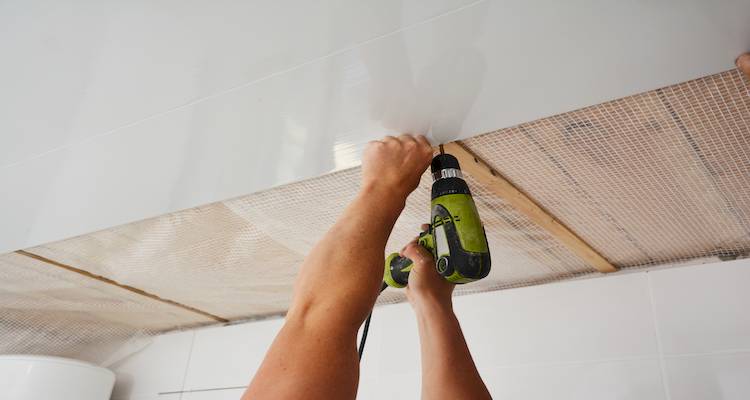
You can save on labour costs by doing some of the work yourself. If you need to remove your old ceiling, doing this before the fitter arrives will save you paying extra labour fees.
Supply Only Costs
Ceiling panels are usually screwed, stapled, or glued into place, and many fitters use a combination of adhesive and staples. They can be fixed directly onto a plaster, artexed, or lath and plaster ceiling, as long as it's sound, even, and free of asbestos.
In a new or newly constructed room, the panels can be fixed straight over the plasterboard, which avoids the need to plaster first.
Depending on how you’re fixing the ceiling boards, you may need some additional items. Below is a table showing the average cost for various supplies for this type of work:
| TYPE OF SUPPLIES | AVERAGE COST |
|---|---|
| Plasterboard | £7 - £20 |
| Ceiling panels | £30 - £50 |
| Staples | £4 - £11 |
| Tape measure | £5 - £20 |
| Adhesive | £1 - £5 |
| Plasterboard fixings | £4 - £8 |
| Joists | £12 - £20 |
| Ceiling battens | £10 - £15 |
Want a custom price?
Post your job
Additional Ceiling Panel Installation Costs
You may need to consider several additional costs when installing ceiling panelling. Below is a list of the additional things that you may need to budget for with this type of work:
Plastering
If your ceiling is uneven, you may need to plaster before adding any panelling. The cost to plaster a ceiling will depend on the size.
However, you can expect to pay anywhere from £240 to £1,050 for this type of work.

How much would it cost to skim a living room ceiling measuring 5.47m x 4.80m?
"Depending on the location of the job, the surface of the ceiling (new plasterboard, artex, or wallpapered) and whether it's flat and a standard height, an honest price would be £250 labour plus materials, with a guideline of £300–£350 all in."
Installing Coving
To give your room a neat finish, you can add in coving to create a seamless join between your walls and ceiling. Coving costs £340 on average, with bespoke coving costing between £400 to £800 in supply costs only.
New Light Fittings
Once your interior cladding panels have been installed, you may then be interested in adding a new light fitting. Light fittings can vary in cost, depending on the style and quality of the light fitting you choose.
The average cost of installing new light fittings in a room is around £80 to £200.
Asbestos Artex Removal
Older ceilings and old textured coatings, such as Artex, sometimes contain asbestos. If there’s any doubt, it needs to be tested first. If asbestos is found, it has to be removed or made safe by someone qualified, and the cost of asbestos Artex removal will be an extra on top of the ceiling panelling itself.
I have just bought a house and, although it's in good condition, I don't like the Artex ceiling, so I'm looking to create smooth ceilings throughout the house. Can you suggest the best solution that doesn't cost too much?
"If you get the Artex tested for asbestos, then the quickest and cheapest solution is to scrape it down, PVA, then skim it. If it does contain asbestos, then you could look at over-boarding the ceiling and then skimming it."
Factors That Impact Ceiling Panel Installation Costs
Several things may affect the overall cost of installing ceiling panelling. Below is a list of the things that may affect the cost of this job:
Type of Ceiling Panelling
As mentioned earlier, ceiling panels come in a range of materials, each at a different price. Lightweight options like polystyrene and pine keep the overall cost down, while premium materials such as solid oak will push the total up considerably.
Size of the Ceiling
The larger the ceiling, the more materials and labour the job requires, so a bigger room will always cost more than a small one. Awkward shapes with lots of cuts around fittings can also add to the time and cost involved.
Condition of the Existing Ceiling
If your ceiling is uneven, damaged, or needs plastering before the panels go up, that adds to the overall cost. Older ceilings may also need to be tested for asbestos, and any removal work will be an extra on top of the panelling.
Ceiling Height and Access
High ceilings or rooms that are hard to reach take longer to work in and may need extra equipment, such as scaffold towers, which pushes up the labour cost.
Location of Property
The location of your property will affect the overall cost of installing ceiling panelling. Those in the London area can expect to pay more for the labour side of the job than those in the north or different parts of the UK. This is because the labour costs in this area tend to be higher across the board than in other parts of the UK.

Number of Tradespeople
The number of tradespeople working on the job will also affect the cost. More people may be required depending on the size and type of panels that you choose. The more tradespeople needed for the job, the higher the overall price is likely for the work.
Ask a Trade
Got a question that only a tradesperson can answer? We have thousands of trades ready to answer any question you may have.
Ask your question

What's Involved in Installing Ceiling Panelling?
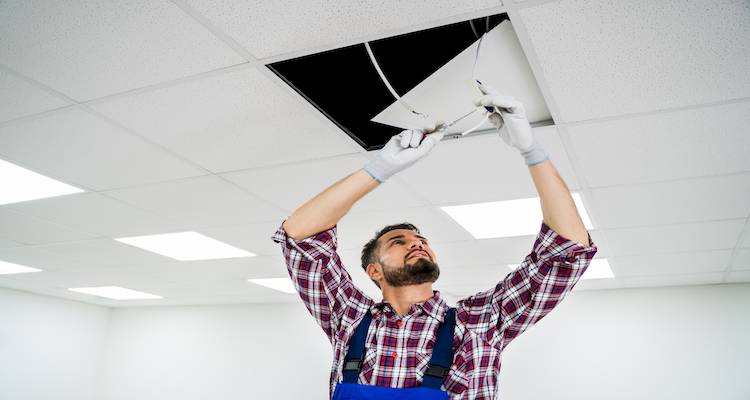
Most homeowners prefer to leave this type of work up to the professionals. This ensures that the job is done correctly and that every aspect of the installation is safe, meaning you won't have to worry.
You can get quotes from multiple local ceiling panel fitters with MyJobQuote, which are fast, free, with no-obligation to go ahead.
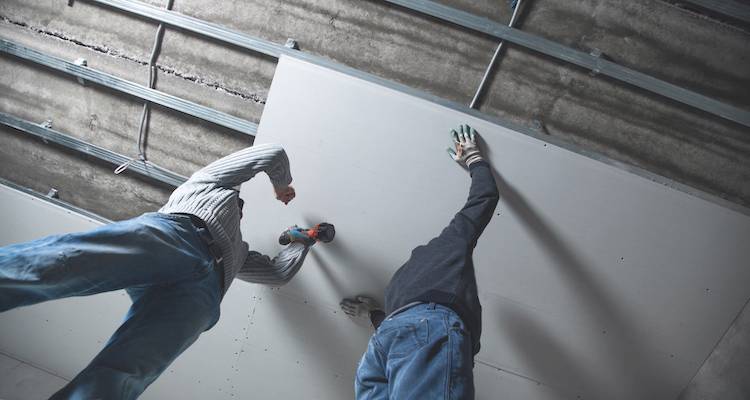
Depending on the type of ceiling panels that are being installed, the method for installing them may vary. However, most of the elements will be the same. Below is a step-by-step guide on installing ceiling PVC panels with start-finish trim.
Before the Job Starts
- Ceiling is Measured — The fitter will measure the ceiling and then cut the back section of the two-part start-finish trim to length.
- Panels are Marked — They’ll measure the ceiling length as accurately as possible and transfer these measurements onto the panels with a pencil before cutting them to size.
During the Job
- Trim is Fixed — The installer fixes this back section to the perimeter of the ceiling with screws at a spacing of approximately 300mm apart.
- Panels are Cut — Panels are cut with a hand saw or table saw.
- Panels Fixed — Once the panels have been cut, adhesive is applied to the back and the panel is secured in place on the ceiling with screws at around 300mm intervals along the tongue section.
- Panels Repeated — This process is repeated for every panel, locking each of them into place with the next using the tongue and groove edges.
After the Job
- Perimeter is Measured — The tradesperson re-measures the perimeter and then cuts and mitres the outer part of the start-finish trim.
- Outer Trim Fitted — The outer trim is clicked firmly into place.
- Edges Finished — The ceiling board installation is now complete. A layer of white silicone can be added around the edges of the trim to remove any small gaps if the walls are uneven.
Types of Ceiling Panelling
There are several different types of ceiling panelling to choose from. Below, we take a look at some of the most common ceiling panelling materials and the pros and cons of each type:
Polystyrene Ceiling Panelling
Polystyrene ceiling panels are the most common type of material for this type of work. They are available in a range of styles and thicknesses and tend to be lightweight and inexpensive. You can choose different effects such as moulded, smooth, plaster, woven, or more.
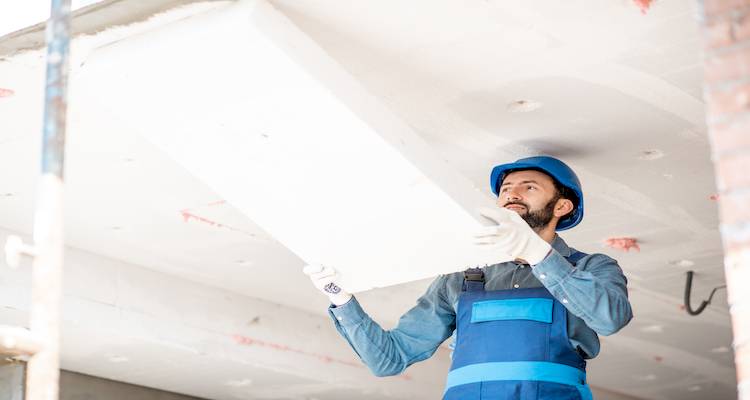
White is usually the most common option. However, you can also find various other colours, including faux wood effects. Alternatively, these ceiling panels can be painted in a colour of your choice.
Pros
- ✔ Low in cost
- ✔ Lightweight
- ✔ Easy to install
- ✔ Various styles to choose from
- ✔ Can be painted
Cons
- ✖ Not as attractive as some other materials
- ✖ They are flammable
PVC Ceiling Panelling
PVC is a material with many benefits. It can be used to create beautiful ceiling panels that are lightweight, resistant to moisture, rot-proof, and resistant to mould and fungi. With this in mind, PVC ceiling panels are great for kitchens and bathrooms. This material is also easy to maintain and comes in a range of colours and styles.
Pros
- ✔ Lightweight
- ✔ Water-resistant
- ✔ Rot-proof
- ✔ Resistant to mould and fungi
- ✔ Great for kitchens and bathrooms
- ✔ Easy to maintain
- ✔ Comes in a range of colours and styles
Cons
- ✖ Can warp over time if exposed to heat
- ✖ Not the most attractive option
Plaster Ceiling Panelling
These ceiling panels are mostly chosen due to their aesthetic and can be made from either plaster or plasterboard. They are easy to install, lightweight, and a lot of them can be cut very easily using just a knife and a straight edge.
Depending on the brand, some plaster ceiling tiles are moisture-resistant and can provide soundproofing qualities.
Pros
- ✔ Can provide soundproofing qualities
- ✔ Easy to install
- ✔ Lightweight
- ✔ Some brands are water-resistant
Cons
- ✖ They can be quite flimsy
Wood Ceiling Panelling
Wood ceiling panels are known for their style and charm. Most models are made from chipboard or MDF with a wood veneer. These panels come in a range of colours and can be made to look like all different types of wood species.
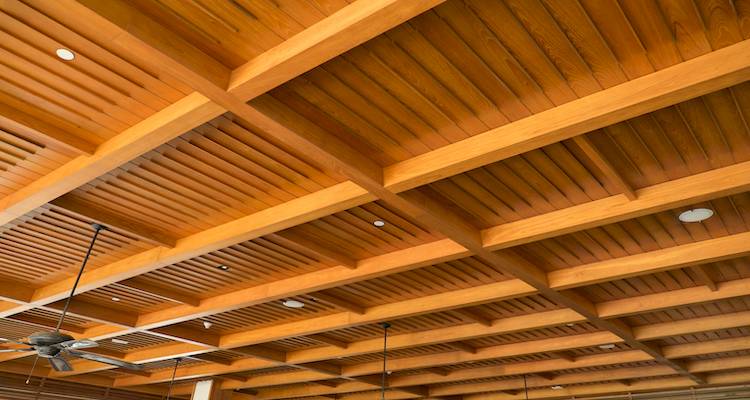
They also come in a range of finishes, including matt, natural, or satin. These panels can be treated to resist water and come in various classes regarding their resistance to fire.
Pros
- ✔ Charming and stylish
- ✔ Come in a range of colours and styles
- ✔ A range of finishes to choose from
- ✔ They can be treated to resist water
Cons
- ✖ They are mostly not very resistant to fire
- ✖ They are not resistant to water unless treated
- ✖ They are more difficult to install
Checklist: Hiring Ceiling Panel Installers
There are many things you may need to consider before hiring a contractor to install ceiling panelling for you. Below is a list of some of the main things that you should consider when finding the right contractor for the job:
- Do they have positive reviews? Check their MyJobQuote profile to see feedback from other homeowners who have hired them.
- Do they offer a guarantee? Ask if your ceiling panel fitter offers a guarantee on their work, what is covered, and for how long.
- Have you got a detailed quote? Ask for a breakdown of the costs so that you are aware of what's included.
- Do they have experience? Make sure they are experienced in ceiling panelling and can show you examples of previous work.
- Is waste removal included? Check if waste removal is included in the job, or if this is an extra cost.
- Do they have insurance? Look for public liability insurance, and employer's liability insurance if they bring someone with them.
FAQs
Can I install ceiling panelling myself?
In some cases, you can install ceiling panelling yourself as a DIY project, which saves on labour costs. Lighter options like polystyrene and PVC are relatively easy to fit, but heavier materials such as wood are much harder to handle and usually need more than one person. If the panels are heavy, the ceiling needs prep work, or you're not confident, it's worth hiring a professional to avoid costly mistakes.
Do I need an electrician for light fittings when the ceiling is panelled?
If your light fittings are being moved, replaced with spotlights, or need to be made safe while the panelling goes up, that part should be done by an electrician. Refitting in the same place may be included, but additional electrical work is usually considered separate.
Can ceiling panelling be used to hide cables or small pipework?
Ceiling panels can cover shallow services if the fitter leaves a little space above them, which is often a cheaper, neater alternative to chasing cables or pipes into the ceiling. It just needs planning before the panels go on, with anything that might need work later kept reachable.
Will ceiling panelling reduce the height of my room?
You'll lose a little height, as the panels sit on what's already there. Fixing them straight to the ceiling only loses a small amount and keeps costs down, but building a frame or battens loses a bit more height and adds to the labour cost.
Is ceiling panelling cheaper than replastering a ceiling?
It depends on the condition of your ceiling. Skimming a sound, even ceiling can work out cheaper, but panelling can cover cracks, holes, and uneven patches without the prep work, which can save money if the ceiling would otherwise need repairing first. For badly damaged ceilings, panelling is often the more cost-effective route.
Is a suspended ceiling more expensive than ceiling panelling?
Usually, yes. A false or suspended ceiling involves building a metal grid below the existing ceiling, so it tends to cost more than fixing panels directly in place. Panelling is generally the cheaper option unless you specifically need the gap above for insulation, soundproofing, or to hide pipework and cables.
Do I need to repair holes or cracks before fitting ceiling panels?
Not always, and this is one of the cost benefits of panelling — it can cover minor cracks, holes, and uneven patches without repairs first. However, if the ceiling is badly damaged or sagging, it's worth fixing that before panelling to avoid problems later, which will add to the overall cost.
How much does a tongue-and-groove ceiling cost?
Tongue-and-groove ceilings are usually made from timber cladding such as pine, with the boards costing around £15 to £30 per m², plus labour. It's a popular budget-friendly option, though the boards take a little longer to fit than larger panels.
How much does bathroom ceiling cladding cost?
Bathroom ceiling cladding is usually PVC, as it's water-resistant, rot-proof, and easy to wipe clean. The panels typically cost around £30 to £100 per m², plus labour, making it one of the more affordable and practical options for kitchens and bathrooms.
Does ceiling panelling add value to your home?
Ceiling panelling is mainly a decorative upgrade rather than a guaranteed way to add value, but a neat, well-finished ceiling can make a room more appealing to buyers. It can also hide damage and imperfections, which may save on repair costs before selling.